Orthodox Vital-Art Canon
Last and First MenThe Orthodox Vital-Art Canon sets the ethical and aesthetic terms for biological creation among the Third Men. It demands more than beautiful or powerful individual organisms: each type must fit its function, and the planet’s living world must form a coherent whole. Against this cooperative ideal stands a rival art that treats biological conflict and the destruction of higher types as sources of tragic beauty. The difference shapes both the practice of Vital Art and the conflicts surrounding it.
A canon for the whole living world
The canon’s central principle is harmony at two scales. An organism should be internally suited to its way of life, with no harmful remnants of an earlier mode of existence and no capacities that work against one another. But the aim is not simply to perfect one species at a time. The planet’s fauna and flora, from humble organisms to humanity, should together form a functioning and aesthetically ordered system, with each species and variety fulfilling its part in the larger cycle of life.
This planetary scale sets a firm limit on what counts as success. A type must not prosper by destroying one above it in the living order. Nor should an artist accidentally damage a higher type while trying to create a lower one. A new organism is therefore not judged only by its own traits or by the ingenuity of its maker. Its place and effects within the wider living economy matter too. The ultimate work is a world of interrelated forms, not a collection of isolated marvels.
Permitted aims and methods
Practitioners could follow more than one recognized path while remaining within the orthodox ideal. They might improve an existing organism by strengthening useful capacities and removing traits considered harmful or useless. Alternatively, they might create a new type to occupy an unfilled ecological niche. That work began with selecting a suitable organism and remaking it according to a plan for a harmonious nature adapted to a new way of life.
The canon thus makes restraint part of artistic competence. It forbids reducing a higher type to a lower one and condemns wasting a type’s capacities. These restrictions follow from the principle that the real object of creation is not an individual specimen but a systematic, planet-wide community of life. Mankind is understood as both creature and instrument within that undertaking; the ultimate artist, under the divine order described in the book, is humanity acting collectively.
The rival art of the grotesque
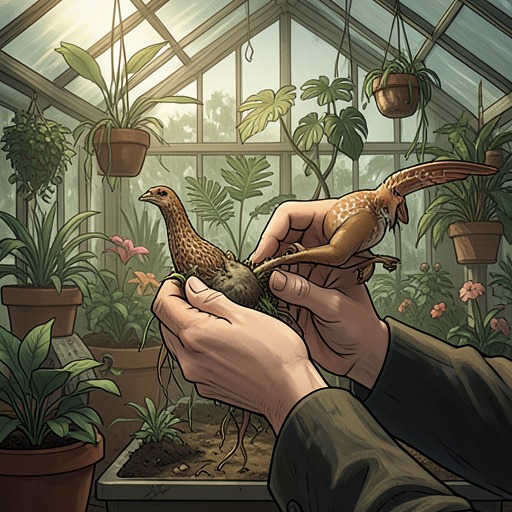
The orthodox ideal never wholly eliminates fascination with organisms that contradict or frustrate their own form. The book describes a competing, sadistic tendency in which biological manipulation produces discordant or dysfunctional creatures. Examples include a bird capable of exceptional speed but unable to feed or reproduce without human support, and a winged mammal whose proportions prevent flight. Other experiments include a two-headed eagle and a deer whose tail develops into a second head, complete with a brain and sensory organs.
Such creations make internal contradiction an artistic end rather than a problem to solve. Their admirers find a kind of tragic beauty in a lower type overcoming a higher one, a principle directly opposed to the orthodox ban on that outcome. The divide is not merely theoretical: adherents of the rival practice devise parasites against the products of orthodox art, and the opposing groups sometimes enter into violent conflict. The canon therefore defines a contested boundary between planned ecological cooperation and deliberate biological subversion.
Artists, research, and public judgment
The practice of Vital Art is widespread, though artists respond differently to the canon. A few reject its principles and gain recognition for grotesque creations. Some of the less successful dissidents accept ostracism or martyrdom rather than abandon their work, which they present as a symbol of tragedy in living nature. Most practitioners, however, accept the sacred standard and work within its recognized modes.
Orthodox practice depends on knowledge as well as intention. Early efforts achieve little until biological science advances beyond the breeding techniques known to the Second Men. Thousands of years of research are needed to understand heredity in greater detail and manipulate hereditary factors in the germ. As biological inquiry deepens, it also opens new regions of chemistry and physics; those sciences consequently develop in a biological framework, treating the electron as an organism and the cosmos as an organic whole.
The resulting culture gives both practical and aesthetic creations a public setting. At recurring shows in major communications centres, new organisms are tested, judged by high priests of Vital Art, awarded distinctions, and consecrated through religious ceremony. Exhibits range from improved crops, cattle, and working animals to organisms designed for agricultural or digestive functions, alongside creations pursued for aesthetic purposes. These displays enact the canon’s claim that biological invention is accountable to shared standards, not only to a maker’s private ambition.
Significance within the history of human design
The canon belongs to a much longer movement in which human effort increasingly turns toward remaking physical and mental nature. Across successive cultures, biological experimentation can serve either a system-wide ideal or a narrower appetite for power and spectacle. The canon gives the former a demanding criterion: improvement must preserve internal harmony and contribute to the whole living order, rather than sacrifice function or other forms of life for a striking individual result.
That ideal remains difficult to realize. It requires generations of research, collective judgment, and limits on what artists may count as achievement; meanwhile, the rival fascination with discord and destructive reversal persists. The canon’s significance lies in holding those pressures together. It imagines biological art not as mastery over isolated organisms, but as a cooperative undertaking whose measure is the condition of the living world they share.